Grades run from 1, back pain with normal walking, to 5, paralysis with no deep pain sensation. The grade sets the pace: 1 and 2 usually start with strict rest and pain control, 3 and 4 go for imaging and usually surgery, and 5 is an emergency measured in hours.
A dachshund that cannot walk gets a number within minutes of arriving at the clinic, and that number decides almost everything that follows: whether the dog is imaged tonight, whether a surgeon is called, whether the next six weeks happen in a crate or in an operating theatre.
What the five grades measure
Vets grade a thoracolumbar disc extrusion on a five-point scale that has been in clinical use for decades, usually called the modified Frankel score. Each step describes one more function lost: pain first, then coordination, then the ability to walk, then voluntary movement, and finally the ability to feel a deep pinch in the toe.
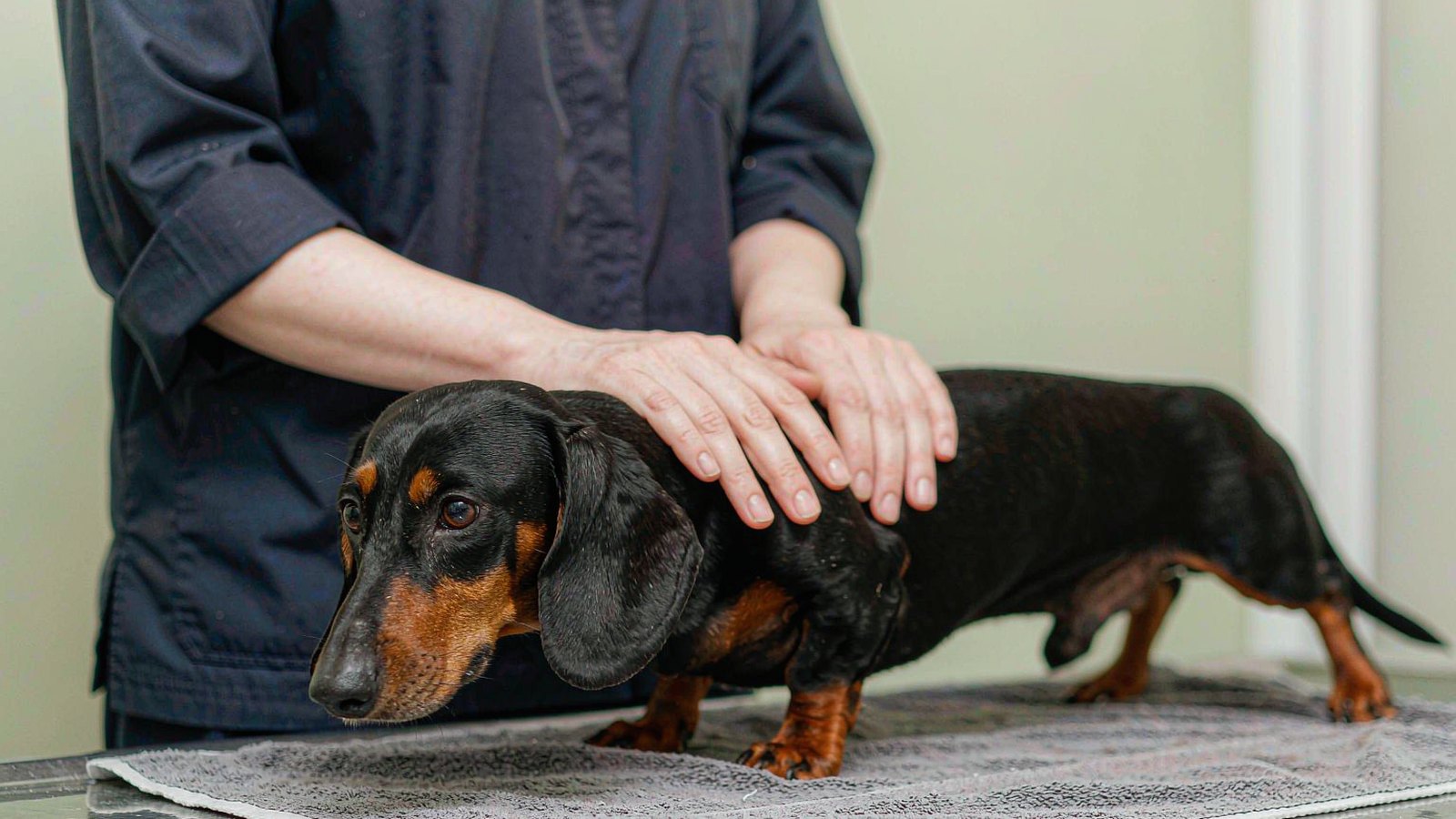
The exam that produces the grade takes a few minutes and involves no imaging. The vet watches the dog walk on a non-slip surface, turns a paw over to see whether it is righted, checks the withdrawal reflex by pinching between the toes, and, only if the dog cannot walk, tests deep pain by applying firm pressure to a toe. Imaging tells a surgeon where the disc is. The grade tells everyone how much cord function is left.
Grade by grade
Grade 1: pain only. The dog walks normally but is reluctant to move, cries when picked up, holds its back arched or its abdomen tense, and may tremble. There is no weakness and no ataxia. This is the grade most often mistaken for a pulled muscle or a stomach ache.
Grade 2: walks, but wobbly. Conscious proprioception is impaired, so a paw knuckles or the back feet cross. The dog can still walk unaided, which is why owners wait. In a dachshund with a long back and low clearance, a mild wobble is easy to miss on carpet and obvious on tile.
Grade 3: can move the legs, cannot walk. The dog is non-ambulatory but keeps voluntary movement. Hold the hindquarters up and the legs step.
Grade 4: paralysed, still feels the toes. No voluntary movement at all, but deep pain is intact. The dog reacts to a toe pinch with its head or voice, not only with a reflex.
Grade 5: paralysed, no deep pain. The most severe grade short of progressive myelomalacia. A firm toe pinch produces no behavioural response.
| Grade | What you see at home | Deep pain | Usual first move |
|---|---|---|---|
| 1 | Walks normally, yelps when lifted, arched back | Not tested | Same-day vet visit, rest, analgesia |
| 2 | Walks but wobbly, paws knuckle | Intact | Same-day vet visit, strict rest, discuss referral |
| 3 | Cannot walk, legs still move when supported | Intact | Referral for imaging, usually surgery |
| 4 | No leg movement, reacts to a toe pinch | Intact | Surgery, ideally within 24–48 hours |
| 5 | No leg movement, no reaction to a toe pinch | Absent | Emergency referral, hour-level urgency |
Why deep pain is the dividing line
Deep pain is carried by the smallest, least myelinated fibres in the cord, and it is the last function to disappear as compression worsens. That makes it the strongest single prognostic sign in the whole exam, and the thing that separates grade 4 from grade 5.
It also marks where the evidence changes. A 2017 systematic review and meta-analysis pooled case series of non-ambulatory dogs and found mean recovery proportions of 93% for grade 3, 93% for grade 4 and 61% for grade 5 after hemilaminectomy, against 79%, 62% and 10% with conservative treatment (Langerhuus & Miles, The Veterinary Journal). Those are between-study comparisons without controls, so they flatter surgery somewhat. The direction is still hard to argue with.
Absent deep pain is not the end of the conversation. A 2023 prospective study followed 36 dogs that had been without deep pain for more than 96 hours, between four and 60 days, before surgery. Just under half, 47.2%, recovered functional walking, with a median time to recovery of 30 days (Ripplinger et al.). Long, expensive, uncertain, yes. Hopeless, no.
What the grade changes about treatment
The 2022 ACVIM consensus statement draws the practical line at ambulation. Dogs that can still walk, grades 1 and 2, are usually started on strict activity restriction and pain control, with surgery as an option rather than a default. Dogs that cannot walk are recommended for advanced imaging and, in most cases, decompressive surgery (Olby et al., J Vet Intern Med).
The same statement is unusually honest about timing. The panel found the evidence for “the earlier the better” weaker than the rhetoric suggests, while still treating grade 5 as urgent. What the evidence does support is that a dog getting worse hour by hour should not be sitting at home waiting for a Monday appointment.
Steroids are the other place owners arrive with expectations. A randomised, placebo-controlled trial of methylprednisolone sodium succinate and polyethylene glycol in 63 dogs with acute severe thoracolumbar disc herniation found no difference in outcome between either drug and placebo (Olby et al., 2016). Pain control and decompression do the work; the injection does not.
What the grade does not tell you
Three things, all of which matter.
It does not measure pain. A grade 2 dog can be in agony; a grade 5 dog may feel nothing because the cord can no longer carry the signal. Analgesia is planned from behaviour and examination, not from the number.
It does not predict recurrence. In a study of 92 dogs treated with hemilaminectomy alone, clinical signs came back in 36% of them, and the presence of one completely degenerate disc elsewhere in the thoracolumbar spine raised the hazard ratio for recurrence to 2.92 (Longo et al., J Vet Intern Med). The grade at presentation said nothing about that risk.
And it is not stable. A grade is a snapshot taken in one room on one afternoon. A dog that arrives at grade 2 and cannot walk two hours later has been re-graded by the disease, not by the vet.
A dog that loses the ability to walk, loses deep pain, or develops a sudden upward-moving band of numbness and weakness is a same-hour emergency. Progressive myelomalacia, an ascending necrosis of the cord, is the reason. It cannot be reversed, and the decision it forces is different from the one you were making an hour earlier.

Working out the grade at home is not the point
Owners often want a number before they call. It is the wrong thing to chase. The distinction that changes what you do tonight is much coarser than five grades: can the dog walk, is it getting worse, can it urinate. Those three answers are enough to decide between a routine appointment and an emergency hospital, and all of them are things you can observe without touching the dog’s spine.
What you should not do is test deep pain yourself. Pinching a toe hard enough to answer the question hurts, and a dog already in pain may bite the person trying. Leave it to the exam, and keep the dog still until you get there. If crate rest is where you end up, the first week of it is covered in what the recovery weeks actually involve.
Can a grade 5 dog walk again?
Sometimes. In the 2023 series of 36 dogs that had lost deep pain for more than 96 hours, 47.2% recovered functional walking after surgery, with a median of 30 days to get there. Dogs operated within 24–48 hours of losing deep pain do better than that, so grade 5 is treated as an emergency rather than a poor prognosis.
How quickly does IVDD move through the grades?
It can move in hours or never move at all. Some dogs sit at grade 1 for a week and improve; others go from walking to grade 4 in an afternoon. That variability is the reason a dog with new weakness is seen the same day rather than watched for a few days.
Is grade 1 an emergency?
Not usually, but it is a same-day appointment. Grade 1 is the stage where rest and analgesia have the best chance of ending the episode without surgery, and it is also the stage most easily confused with something else. Waiting a week to see how it goes is how grade 1 becomes grade 3.
Does a higher grade mean more pain?
No. Pain is often worst in the early grades, when the nerve root and meninges are inflamed but the cord still carries sensation. Dogs at grade 5 may show no pain response at all. That is a neurological finding, not comfort.
Grade definitions and treatment recommendations follow the 2022 ACVIM consensus statement on acute thoracolumbar intervertebral disc extrusion. Recovery proportions by grade come from the 2017 systematic review and meta-analysis; outcomes after prolonged loss of deep pain from Ripplinger et al., 2023; the steroid trial from Olby et al., 2016; recurrence data from Longo et al., 2021. Figures in the table reflect those sources and our reading of them, not a single study.
Medical note: This article is for general information and does not replace veterinary advice. Dachshund back disease can progress within hours. If your dog is showing signs of pain, weakness, or loss of bladder control, contact your veterinarian or an emergency clinic now. See our editorial standards for how we source and review this material.